Attic ventilation thatearns its keep year-round.
The most overlooked part of a roof. Balanced intake and exhaust keeps the deck cold so ice dams don't form in February, and pulls heat out in July so your shingles last and your AC isn't fighting the attic.
The short answer
It's all about balance
Cool air comes in low at the soffits and hot air leaves high at the ridge. Code wants about 1 square foot of vent per 150 square feet of attic, split roughly even between intake and exhaust. The single most common problem we find isn't too little exhaust, it's intake that's undersized or buried under insulation, so the system can't move air at all.
We size it on net free area (the real opening after screens and baffles), not the gross hole, which is where a lot of builder ventilation falls short.
Why it matters
What a starved attic costs you
Ice dams
Attic heat melts snow that refreezes at the eave, backs water under the shingles, and tears at the gutters.
Cooked shingles
A trapped 150-160F attic bakes the shingles from below and ages them years early.
Moisture & rot
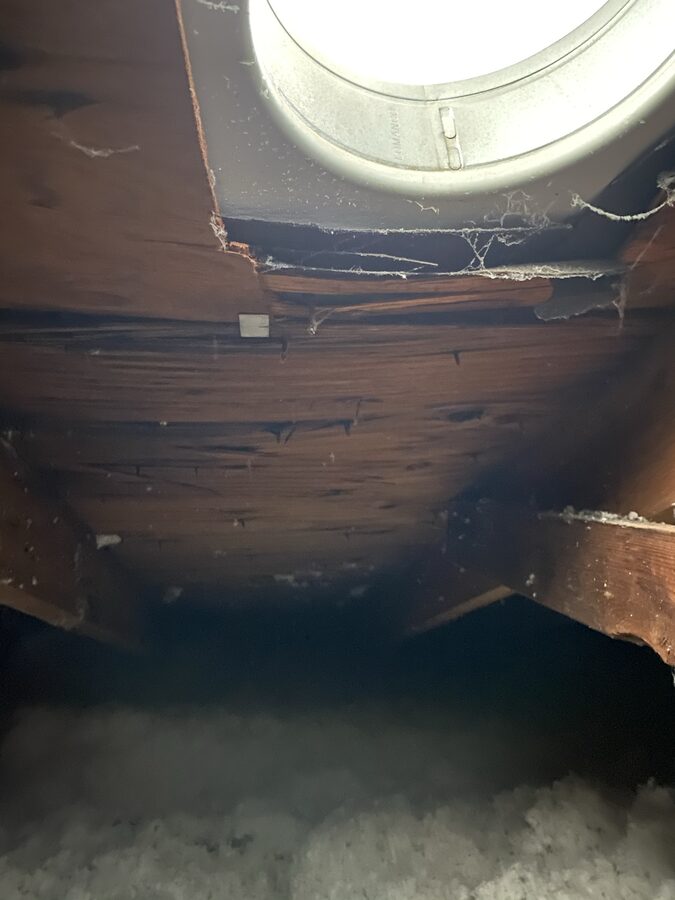
House humidity condenses on a cold deck in winter, leading to mold and rotted sheathing.
Higher bills
That heat radiates into the house, so the AC works harder all summer.
The parts
What we install
Ridge vents
Continuous exhaust along the whole peak (about 18 sq in of net free area per foot), with baffles to keep rain and snow out. The first choice when the ridge and soffits can feed it.
Turbine & static vents
For short ridges or older roofs. Turbines move air on any breeze; static vents are simple and passive. Both make up exhaust where a ridge vent can't.
Soffit & intake
The half everyone forgets. Continuous soffit intake (kept clear of insulation) is what actually makes the exhaust work.
Best time to fix it
During a roof replacement, when the vents integrate cleanly with the new shingle system.
Questions
Common questions about ventilation
Will better ventilation stop ice dams?
It cuts them way down by keeping the roof deck cold so snow doesn't melt and refreeze at the eave. Pair it with air sealing and the difference is dramatic. North-facing, shaded eaves may still ice a little, but nothing like an under-ventilated attic.
What's the best type of roof ventilation?
A continuous ridge vent with matching soffit intake, when the roof has the ridge length and the eaves to feed it. Short ridges get turbines or static vents to make up the exhaust. There’s no one answer; it depends on the roof.
Why is my attic still hot with vents?
Attics are supposed to be hot in summer. Good ventilation takes a 150-160F attic down to about 120-130F, and that 20-30 degree drop is what saves your shingles and your AC bill. The goal is managing the heat, not chilling the attic.
Can you have too much ventilation?
Yes, if it’s unbalanced. Too much exhaust without matching intake pulls conditioned air out of the house and can let wind-driven rain in. Matched intake and exhaust beats oversized exhaust every time.
Should I close the vents in winter?
No. Closing vents traps moisture from the house in the attic and causes rot and mold. You want a cold attic in winter, with insulation on the floor and air still moving. Ice dams come from too little ventilation, not too much.
How do I know if mine is adequate?
Few or no ice dams, an attic within 20-30 degrees of outside on a summer afternoon, and no moisture or mold on the deck. Ice at the eaves, heavy granule loss, musty smells, or hot spots mean it’s short. We calculate the net free area against code during an inspection.
Ice dams or a roasting attic?
We'll check the balance, calculate what it actually needs, and fix the cause.